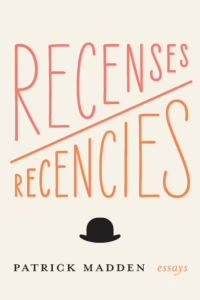
In his newest essay collection, Recenses/Recencies (University of Nebraska Press, 2026), Patrick Madden is indeed essaying the essay. His signature microscopic lens on linguistics and etymology is anything but ho-hum in this whimsical look at how time shapes language, and vice versa.
The premise of this 196-page collection is the failure of language to capture our experiences, and how, as Madden suggests, “….the coolest meanings are the unresolved ones,…that resist or reject the notion that a particular finite meaning is even desirable, let alone attainable.” (71)
Madden begins each of the thirty essays with the phrase “I have just…” as ode to Montaigne’s essay “Of a Monstrous Child” in which he begins, “I have just seen a shepherd in Médoc, thirty years old….” A scholar of Montaigne, Madden pays homage to that inquiry, agreeing that “[t]he story wends its own way. The writer follows where it goes. So that’s what I’m practicing here.” (3) To that end, no essay carries a title, as if further commenting on the failure of words to easily sum up the whole or a refusal to categorize time.
Writing in the middle of or very near the time of an experience is often taboo for essayists. Instead, we are to process, ponder, and put away our experiences for an indefinite amount of time, having been sent to our waiting rooms until we’re good and ready to apologize for having thought ourselves worthy of writing about something so soon. And yet, these essays challenge the proscriptive notion that one must write from a distanced perspective of contemplation and playfully prove that assessment can and does exist in the present.
The opening lines of each piece take on that immediacy: “I have just showered…,” “I have just finished reading…,” “I have just motivations…,” or “We have just made…” (99). The reader will delight in these tiny shifts in parts of speech or using only once the collective “we,” as they are not by accident. From there we are led by quick turns into associative connections. Meandering is the point, and while each bite-size essay does stop, they don’t end. We get the sense they extend far beyond the page.
Whether wondering where his returned Gorilla suit ended up, staging a re-creation of being pickpocketed in Boston, overhearing a private conversation in a grocery parking lot, seeing Darwin’s bathtub in Uruguay, or making his wife her morning Postum (cebada), these essays swirl in notions of time. In the latter essay, making the daily ritual of barley and milk, Madden leads us to the very large idea that writing itself is a parallel universe. “The act of reading revives the things written, happens them again.” (118) Madden is writing simultaneously in the present—about making his wife her morning drink and being dangerously low on sugar to sweeten it—but also from a distance—essaying on the patterns and routines of the everyday and the fact that eventually, when we die, “we run out of ingredients.” The assumed future reader can return to these memories, whose context has since been altered. Every essay is a portal back to the frightening experience at a beach, to the airport, to a concert, to an old, dear friend and mentor, to who we were at another moment in time. Madden mirrors the immediacy of thoughts while also making those thoughts permanent: “(The essay is written in the eternal now.)” (97)
This statement is a particularly tender reflection in that his dear friend Brian Doyle, since passed, returns to the present in the essays’ words. The theme of recurrence gives the reader a pleasant feeling of familiarity. Across several essays, we learn some particulars of Doyle we might otherwise not have known. The weaving creates an accumulation of intimacies. Madden employs this throughout, and thus the word collection is fitting for this book. The reader collects words and ideas along the way, which Madden will use in subsequent essays without fanfare, tucked away just for the reader to discover. One essay delves into the word riptide, another fain, another awoken, so don’t be surprised when that word pops up in another essay, which we can now come to with our newfound recognition. In this way, Madden constructs a temporal thought experiment within the confines of this book.
Madden strengthens this timeplay with referential interjections in each essay. As when he physically alters the pace of the prose with “I’m verbally slowing things down here in the essay…something about the rhythm of the recounting wants to hold on a beat before we get the circular apse” (44) or “If I seem to be stalling, revving my engine, it’s because there are so many moving parts that have to fall into place” (103). The conversational asides feel as though we are sitting across the table from the author as he (re)tells each story.
Madden is also no stranger to wordplay. Right there, he would call to task the phrase “is no stranger to.” In this collection, he crosshatches margin annotations and sprinkles in translations, melodies, illustrations, city maps, Webb Telescope images, and sketches. Most of all, he incorporates “playfulnessness,” a word used by Doyle that comes to stand for language itself. Madden calls out editors for changing playfullnessness to playfulness or omitting the seemingly innocuous a from a title, which changes everything. Several of his annotations simply state “maddening.” Language itself is indeed the theme of this book, how much of it is conditioned or borrowed or intended. “I don’t dress sharp, so grammar is my way of being fancy,” says Madden (83).
“I have just decided this essay was predetermined…” (69) sums up the wit and whimsy of this archive on the language of time. Madden’s recenses and recencies are indeed indefinable, sometimes maddening, but always packed with playfulnessness.
Recenses/Recencies is available at University of Nebraska Press.

Jocelyn Winn
Jocelyn Winn is the Nonfiction Editor for The Maine Review as well as the founder of The Eleventh Letter editorial services, with a brick-and-mortar Writing Gallery in downtown Concord, NH, featuring text-art exhibitions, writing workshops, and literary events. Her recent work is featured in WTWH Media Publications, Kemper Museum of Contemporary Art, Eratio, The Waterwheel Review as a Pushcart Prize nominee, and Fourth Genre as a Steinberg Memorial Essay Prize finalist. She holds an MFA in Writing from Vermont College of Fine Arts. She can be found at www.theeleventhletter.com. You can reach her at jocelyn@mainereview.com.