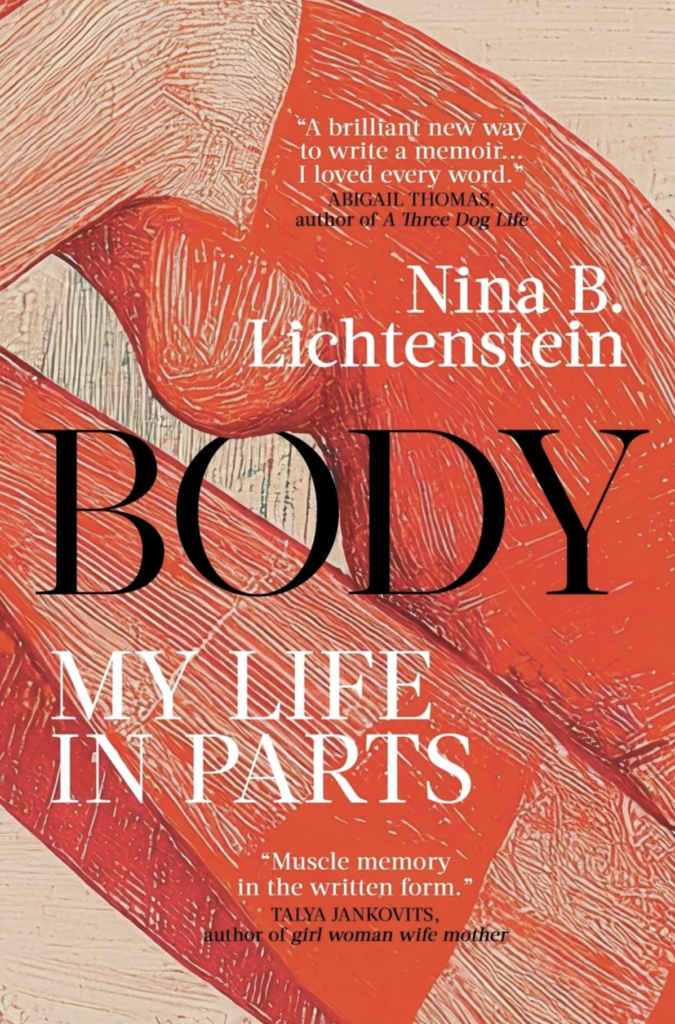
Nina B. Lichtenstein is an expat Norwegian Lutheran turned American Viking Jewess with life and teaching experience from three continents. As readers will discover, Lichtenstein is the kind of salt-of-the-earth woman everyone talks about; she adds flavor, positive influence, and kindness to her endeavors and the communities she touches. Luckily, she eloquently captures her flair and pragmatism in scintillating stories most people can relate to, as if it were their body parts that lived to tell the tale. Body parts, you ask? That’s right, her debut memoir, Body: My Life in Parts (Vine Leaves Press), is nothing short of a brilliant new way to write a memoir, per one of the blurbs on the book’s front matter (and I concur). She is part of the rare few who can accurately portray themselves with writing that carves away the meat, fat, and gristle, leaving only the bone, and maybe a few juicy bits. With chapters titled Hair, Skin, Hips, and Knees, one can only imagine the fascinating tales that brought them to the forefront.
Lichtenstein recently sat down with our Fiction Editor, David Grubb, to talk about how she uses body writing in her memoir for too many devices to name. She’ll also delve into how the embryonic root plays/played its part in her most recent work, as well as some of those early pieces from days gone by.
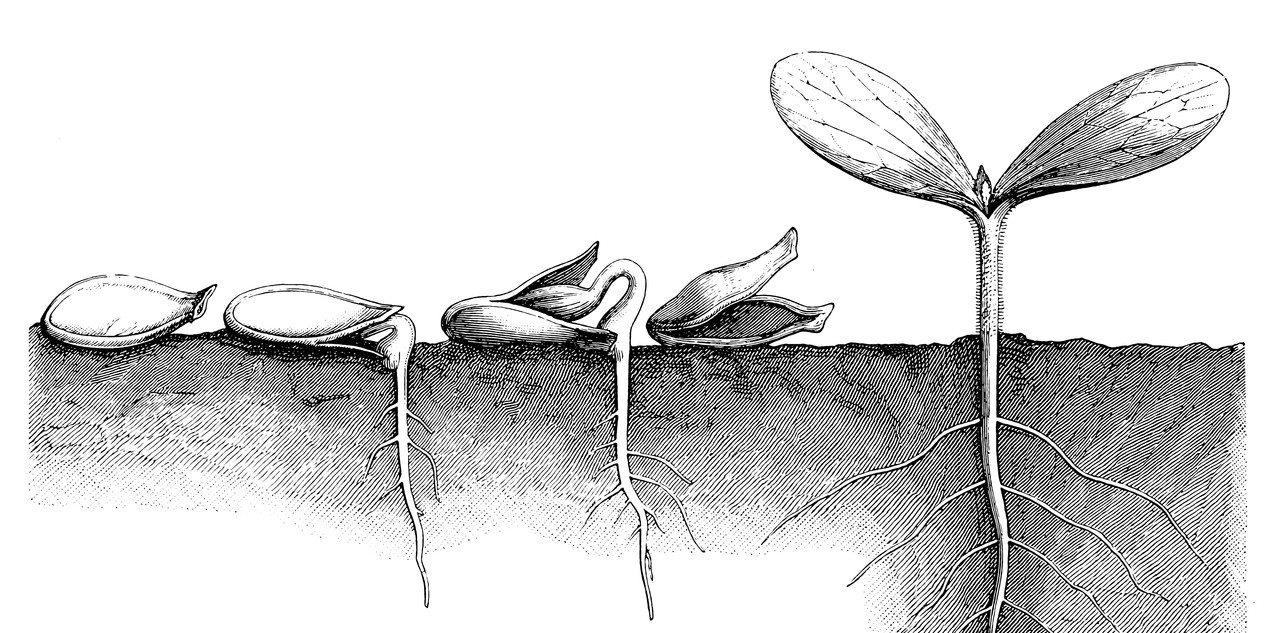
David: In botany, the radicle is the primary root, the first organ to appear when a seed germinates. It grows downward into the soil, anchoring the seedling, as secondary roots grow laterally. What do you consider to be the radicle of your writing career? If that’s too broad, the radicle of your memoir would be as enlightening, perhaps even more so.
Nina: Since I was a young teenager, I used writing as a way to process and metabolize life experiences. I never journaled but would send letters (galore!) to the editor of Norway’s weekly youth magazine, and I also wrote a lot of letters, pages and pages of letters, to girlfriends, about thoughts and feelings in a totally untamed, free language. Once I became an academic living in the U.S., with a PhD in French, my voice had been shaped into the infamous “academese”–pompous, formal, verbose, and maybe even smug. I did what academics are supposed to do: publish articles, present at conferences, and publish “the book.” Then, when my marriage started crumbling, and I spent a year in Norway with my kids, I was commissioned to write a column, “The Ex-Pat Chat,” for a Norwegian-American newspaper. Oh boy, did I have fun with that! It was the beginning—the radicle?—of my authentic voice. During separation and eventual divorce, I wrote my heart out, first by blogging, then by having many of my personal essays accepted for publication, which was extremely gratifying. After a move to Maine, now as an empty nester, I quit the adjuncting I had done for 6 years, shifted gears, and was accepted to USM’s Stonecoast writing program in creative nonfiction. I wanted to hone my craft, connect to a writing community in Maine, and develop that voice to the best of my ability. The Body book came out of my time at Stonecoast. As far as the radicle for the memoir, I have come to understand embodied writing, something that seemed almost necessary or perhaps pre-destined for me, as something that helps me feel rooted. It is for me writing that anchors the ADHD, monkey-mind Nina, who, since she was a young child, has struggled with being all over the place, both physically, mentally, and emotionally. In this, my first memoir has served me well.
David: Looking back at your writing radicle, what do you wish you’d known then about your writing career that you know now? If you wish to shorten the time span–you’ve come a long way from your days in the Stonecoast MFA program–what sage advice would you give a burgeoning writer from what you gleaned in those hallowed halls or after graduation?
Nina: This almost makes me sad to say, but I wish I had pursued creative writing from the start, because not infrequently do I feel like the whole PhD in French thing was a (loooong) and misinformed detour to get to where I am now. I think I pursued French (and other languages: English, Spanish, and Hebrew) because it came easily to me, and I excelled. The advanced degree programs were part of the structure I probably craved (to feel grounded and have “direction”), and I was more interested in pleasing others than listening to my inner voice. The courage to do that came with maturity. So I would advise the burgeoning writer, who, like me, feels that tinge of joy—but also a visceral need—when writing creatively, to go for it. Make time and honor that desire/drive/urge/curiosity. In my own defense (or to comfort myself), I don’t actually think my PhD and academic work were time wasted: I am who I am and have the sensibilities I have today because of all that. And that is good.
David: Can you share a little bit about your writing process with us? In particular, how did your fresh take on the memoir genre develop from a small seed of an idea and germinate into this breathtaking final draft?
Nina: So far, it seems that shorter form works best for me, which may have something to do with my ADHD, and the fact that the Body memoir is essentially a memoir-in-essays, where each chapter is named for a body part, speaks to how this is part of my “process.” As for the fresh take, the itty-bitty seed that started it all, was a severe pain in my hip, one night when I was in my first semester of the MFA. So I wrote toward that pain with curiosity. Oodles of curiosity, asking, and excavating memories and stories connected to my hips. Had my mentor, Suzanne Strempe Shea, not said “give me more of this!” when she read my first 20 pages, the seed might not have continued to grow, but her nourishing words proved the best sunlight and fertilizer for more body-part stories to sprout and eventually blossom into a collection worthy of a book.
David: You have a knack for simplifying your words to ensure they’re as eloquent as possible while still providing great clarity. As an example, Limping on, I groan and realize I’m essentially damaged goods, but that the detailed memory that springs from my knee is a precious treasure, after all (pg 129). Is there a radicle for this precision writing, or does it come naturally from your countless years as an avid oral storyteller?
Nina: I love that you see this as precision writing…because that is something I’ve had to work hard to achieve. Hailing from a Germanic language background (as Norwegian is), I have tended to write long, convoluted, and complex sentences and paragraphs. During my MFA training and various other workshops I have attended over the years, and also, of course, the editing processes I have been part of, both as a writer and an editor, I have (painfully) learned about how a huge part of writing and telling stories well has to do with simplicity. Less is more kind of a thing. And so, the concept of chiseling in order to achieve more clarity has become an exciting and fun challenge in my writing process.
David: Even the title seems like a great story with a fascinating radicle. Can you tell us more about the title? Were there many revisions, or did the writing gods help you strike gold from the onset?
Nina: The title of my final MFA project, from which the book is an evolved version, was “Body: A Life in Parts,” and then someone, an editor perhaps, suggested that it could be understood as, or confused with, a book on anatomy. A quick fix was to make the “A” into “My,” and —ta-da!—we have a fine title for a memoir that also makes it clear that the body parts of a specific woman, me, are part of the story.
David: A little birdie (Facebook or X or both) told me that you’re teaching an upcoming workshop through the Maine Writers Studio titled Your Body, Your Story. What are some of the ways you’ll advise attendees to dutifully represent their memories and experiences using your tried and true system of body writing (the Art and Craft of Body Writing from the Brevity Blog by Nina Lichtenstein)?
Nina: I always open my body-writing workshops by inviting participants to consider a paradigm shift: instead of looking at the world, their exterior world, for inspiration and stories, we will turn inward, but not in some abstract, hippocampus brain kind of way. No, we will collaborate with our body parts through curiosity (and many writing prompts!) and hone our listening skills. By now, we are all aware that our “body keeps the score” as trauma therapist Bessel van der Kolk has coined the term, and I guide curious writers in mining that treasure chest for their own, original stories. This particular workshop coming up will only be open to six writers, and we will meet once a month for six months, and workshop six stories (one by each writer each month). There will be accountability, community, and creativity galore!
David: A follow-up or secondary question, if you will. What are some other ways you advise writers to dutifully represent their memories for the memoir genre (or CNF) if the details are forgotten? Is this an area you excel in, or do you struggle with it, like many authors in this genre?
Nina: As creative writers (vs reporters and journalists, or biographers) we have the privilege of some artistic freedom; however, this freedom also comes with responsibility. And the reality is that memory is often fallible and malleable over time, as it can be shape-shifted by ongoing life impressions, experiences, and traumas, to name a few “influencers.” So, when we are unable to remember an exact detail, I suggest using qualifiers like “perhaps,” “in my mind’s eye I see,” or “it could have been,” etc. Our writing becomes richer, more nuanced and interesting when we can suggest or show the reader worldbuilding details in scenes, moments, passages, etc.
David: During your reading of Body at Print: A Bookstore in Portland, Maine, on September 25, 2025, which I had the pleasure of attending, you spoke about how your family reacted to your memoir. Will you recount the anecdote of the way your son (now a twenty-nine -year-old man) reacted to the “Vagina” chapter? The humor of the tale is great, but the insight into how our words can truly impact the reader, in particular our friends and family, was enlightening for many of us in attendance.
Nina: Actually, it was after reading the “Hair” chapter, which is essentially about my rebellious teenage years and includes the story of the abortion I had when I was a senior in high school, that he turned to me and said, “So, I just read about your abortion….I had no idea.” I answered that, sure, there are many things about your mamma you probably don’t know…yet. He let that sink in as he flipped through the pages of the book, and then added, “So, what’s the vagina chapter about?” It certainly was a moment! I have been candid in the book, but never for the purpose of creating a shock effect. My goal in writing this memoir was to be honest but also humble, funny, and self-deprecating, yet face my actions and reactions with a sort of grounded and accepting ownership, not to shy away from vulnerability. I am glad that my three sons can discover their mamma on the page in this way.
David: What is your favorite genre or format to write and why? I would guess it’s non-fiction/CNF flash because you’re one of the editors at In A Flash literary magazine, but your recent success in memoir might derail my assumption.
Nina: The reason I have written almost exclusively short-form creative non-fiction so far is because it comes the most naturally for me. Writing in this genre, and in shorter rather than longer forms, is like breathing for me. However, as someone who practices both yoga and mindfulness, I LOVE the idea of longer, slower, and deeper breath, and so, I strive to develop a longer form writing practice. And something interesting is happening: I am starting to feel, dare I say “bored” (?) writing about myself—with the imaginative restrictions this places, by necessity, on my stories.
David: You’re exceptionally prolific and seem to have your hands, nose, heart (Body chapter titles, wink, wink) in so many endeavors all the time. Do you have another memoir forthcoming, and if not, what is your dream project, fiction, nonfiction, or otherwise?
Nina: I do have a few fiction projects brewing that I am excited about. One is autofiction, maybe even two, and yet another is a major historical fiction project that I know will demand rigorous research as well as a kick ass storytelling voice…But I am afraid! Can I do it? Do I have it in me? Another (sad) reality is that the marketing and event-organizing work around Body has been totally time-consuming, eating away at much of my writing time. But now that I’m coming around on the one-year anniversary of Body’s release, I am thinking it’s time to switch gears and focus on the next project.
David: I’ve heard you talk about the age-old advice of writing to an audience of one and its place in a writer’s guidance. It seems you took that to heart early on, but you may not have understood the full value until your book tour took you overseas to your native homeland in Oslo, Norway. Can you elaborate on that experience as it relates to writing to an audience of one?
Nina: Well, clearly, and ideally, we’d like our stories to reach thousands (millions!), and I am all for dreaming and aiming big, far, and wide. However, the important thing is not to let that dream or desire become pressure that stresses us out. In my own time of worrying about “pleasing everybody”—aka all potential readers—especially as I experienced this in my younger academic days—my father once gave me advice that only more recently has become truly meaningful. He said, “Nina, write to the audience of one,” meaning, keep your one reader in mind, tell your story, craft your message, for that one (random, non-descript) reader (imagine a person with a good head and even better listening skills)…and suddenly I could feel my shoulders lower, and the pressure ease off. Also, the tone of your writing voice will likely shift and become more…intimate, which is very helpful in memoir. When it truly hit home, when the metaphor of “reader of one” crossed over to have real-life significance, was last fall when I had a launch event for my memoir in Oslo, my birth city. Out of the audience stepped a woman who presented herself to me as my half-sister, whom I had no idea existed. We share the same father. All I could think of was here is my reader of one! If we can hope that our writing might touch someone, really impact a life, then here it was. My new half-sister would not only learn a lot about me, but more importantly, about our father, whom she never knew. He figures in many of the Body chapters, from my childhood, adolescence, early and later adult years. It was as if the whole project found its purpose in that “reader of one,” that I could never have dreamt about. So my message to the emerging writer is: never underestimate whose life your story can change. That is the potential magic of our art.
David: Finally, do you have any parting advice for writers and other creatives who are still searching for their ‘radicle’?
Nina: Be shamelessly curious! As poet laureate Tracy K. Smith, author of Fear Less, Poetry in Perilous Times, has said, “Curiosity is, at heart, courage; readiness not for a fixed or foretold outcome, but rather a type of uncharted encounter—an adventure.”
Available now at Vine Leaves Press.
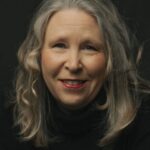
Nina B. Lichtenstein
Nina B. Lichtenstein is a native of Oslo, Norway, but has lived in the US for the past 40 years. She has taught languages, literatures, writing, and Jewish Studies in the US, Norway and Israel, and holds a PHD in French Literature from the University of Connecticut. While her scholarly work deals with the culture and literature of Jews from Arab lands, Nina's personal essays and reported pieces have been published in The Washington Post, The Huff Post, Lilith Magazine, Tablet Magazine, and Brevity Blog, among other places. Most recently, her memoir-in-essays, Body: My Life in Parts, was named a finalist in the Maine Literary Awards 2026 for memoirs. She is also the founder and director of Maine Writers Studio, and the co-founder and co-editor of In a Flash Literary Magazine on Substack. She publishes semi-regularly on her own Substack, "The Viking Jewess and Other Curiosities." Needless to say, Nina enjoys storytelling in all shapes and forms, live and in writing, and most of all, in community.

David Grubb
David Grubb, a retired US Coast Guard Warrant Officer, has been a creative writer his entire life, yet never focused on it because of career and family. In 2013, he flipped the script, and everything is going quite well. Debut novel, A Trip From God Book 1, released on Dec 6, 2022. Debut Children’s Book, Spider Might, released on February 29, 2024. https://www.agrubbylife.com/. You can reach David at david@mainereview.com.