J Brooke’s debut poetry collection, I Can Tell You the Version That Will Make You Take My Side, is an invitation into Brooke’s unique “gender journey”—one that begins in childhood and traces its way into adulthood and through a world that continues to change and challenge the existence of all who dare to step beyond the binary.
In I Can Tell You the Version That Will Make You Take My Side, Brooke—a self-proclaimed “outsider”—gifts witness and wisdom to all of us who have felt othered, and, in reading, we offer witness to Brooke, their story, and the wider social, cultural, and political influences that pull on us all. To celebrate the release of this award-winning collection, Co-Editor Chelsea Jackson sat down with Brooke to talk about the book, their writing process, and what different generations can offer one another.
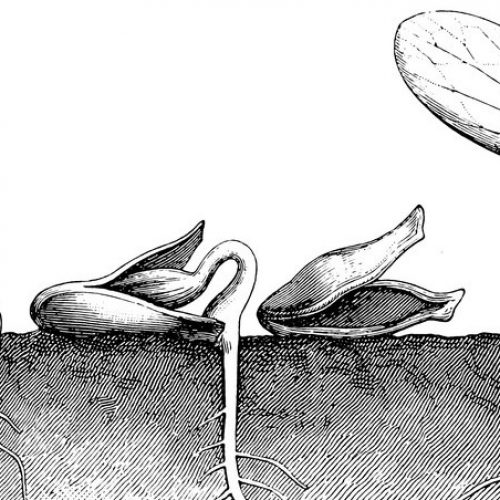
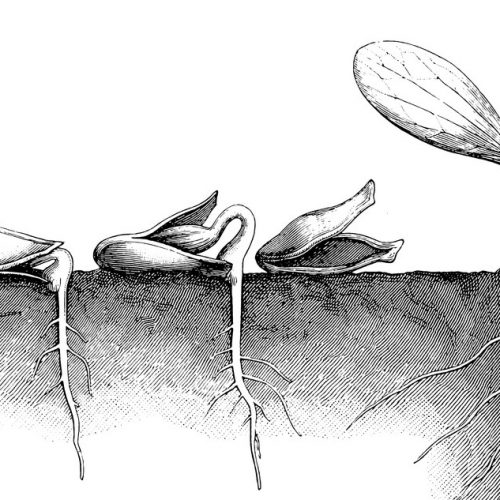
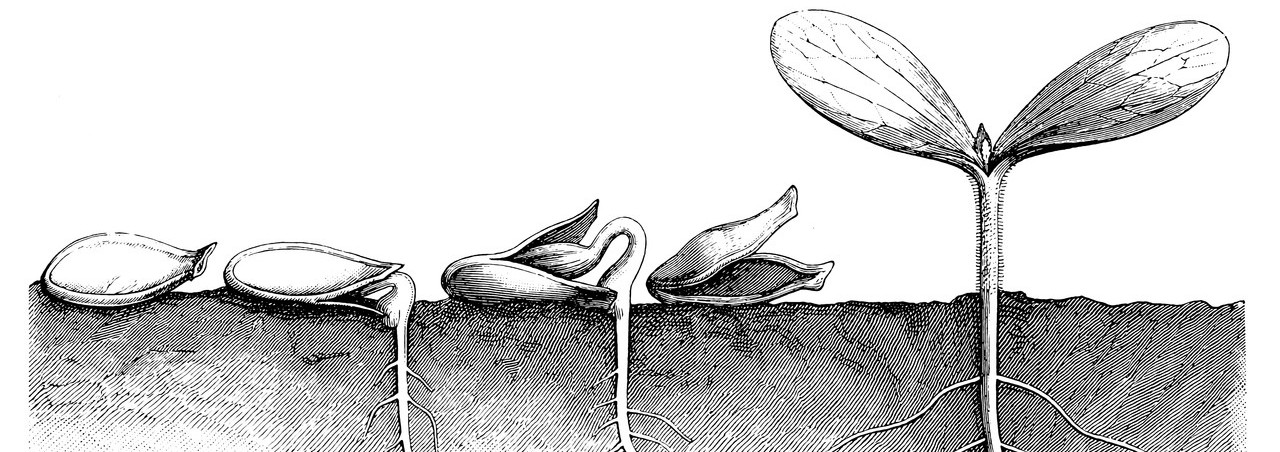
Chelsea Jackson: In botany, the radicle is the primary root, the first organ to appear when a seed germinates. It grows downward into the soil, anchoring the seedling as secondary roots grow laterally. What do you consider to be the radicle, or the anchoring root, of your writing career?
J Brooke: I think being an outsider is probably my radicle. As my closest friends know, I have an insane memory—it goes back to the crib, and my earliest awarenesses were like that illustration of the pie chart where one slice is just slightly pulled away from the circle to show where that triangle fits into the puzzle. I interpreted my immediate world from the perspective of that ajar triangular piece. So for me, my norm was always feeling like I was observing the group or crowd or whatever situation from a slight dislodge…and because my perspective was unglued from the tight circles of any surrounding interactions, it immediately created my internal dialogue, well before I had speech or the ability to write. Over time, that dialogue grew into my writing.
Jackson: I know that you write in other genres, primarily nonfiction. Why was it important for this project to be poetry and for the story you’re telling in the collection to be told in “imagery that floats?”
Brooke: Funny, it’s a question that comes up at nearly every reading I do, and in many interviews…I do think of myself as “not a poet,” and yet, the experience of my book tour has made me think perhaps I’m more of one than I previously acknowledged to myself. I recently heard an interview with Questlove, where he spoke about being approached to be the filmmaker on “Summer of Soul.” He kept saying, “Why do you want me… I’m not a director; I don’t really work in film.” Then, after about a year, he took the question he kept asking himself, “Am I?” and inverted it to “I Am!” to grant himself permission for the project.
So, I want to turn this question you’re asking around and ask: If you didn’t know me from my essay and other prose work, would you ask a version of this question? I don’t mean that to be challenging, but rather to have you consider the poems in this collection—what they are about and how they communicate—and assess why they work in the form they exist as. In other words, are there instances where you read a poem like “Cancer Scare” and think, “Man, I sure wish I had the long prose take on this?” Because I think an essay on me having a breast cancer scare could be well-written, but 27 couplets where only 7 of them are about breast cancer and the rest are about the misgendered body I was born in weigh the experience in a way prose would struggle with. Prose would have to work too hard to place the emphasis where it belongs, and the reader experiences that overwork. Prose also doesn’t allow for the subtext of couplets in a discussion of breasts. I think that’s what I reference when I answered an earlier interview with the explanation of “imagery that floats.” But floating, in all my work, is something I strive to achieve, and the practice of poetry is absolutely more geared to it—just like I can work on my flexibility on a bicycle or a yoga mat, but one modality is simply more suited to the goal.
I studied with Billy Collins a bit before attending grad school, and I bristled whenever he repeatedly claimed, “Poetry is a bird and prose is a potato,” because I didn’t want to think I was largely writing potatoes. No shade to the Solanum tuberosum (note: I see and raise your first question invoking “radicals”), but when I worked in advertising, we would call a bad piece of creative work “a latke,” because it just lay there cold and greasy. That was my internal imagery when Collins would potato-bash; that if I didn’t write my stories in poetic form, the stories wouldn’t soar. But over time, my thinking changed (maybe it was after seeing Matt Damon avoid starvation in “The Martian” via potato), and I think Collins meant something more subtle than “prose sucks and poetry doesn’t”—and that’s the floating I refer to. When I look at some of my favorite poems (like much of Carolina Ebeid and Tracy K. Smith’s work, as well as countless—COUNTLESS—others), I find the physical words levitating off the page. In these instances, created through form and word choice, there’s the opposite of density; a lightness emerges from the air and space surrounding lines and words, and the result feels magical.
Jackson: I appreciate the gradual realization that you might also claim the title of “poet.” Personally, I had the opposite experience, where I started as a “poet,” and it took me well into writing in other genres to feel confident enough to adopt the term “writer.” But my expansion into other forms started for some of the reasons you mention; poetry and prose often offer different inroads into a topic or memory, which provide different results and reading experiences. For me, one of the joys of writing in multiple genres is exploring the various ways the same topic or experience can be written about and following the “pull” of one form over another based on how that topic or experience wants to be witnessed.
Speaking of these differences, while language can be used in surprising ways no matter the genre, poetry seems to offer the most freedom when it comes to breaking through inherited frameworks. Poets can often unapologetically scrap literary “rules” and create their own line by line and poem by poem. For me, this mirrors some of the power embedded in the non-binary and queer experience. Were there moments when you leveraged specific craft elements in a way that reinforced or captured the complex “gender journey” you’re writing about?
Brooke: Sure—thanks for this question, because I think it helps people who have only seen/heard me read my poems and haven’t experienced them on the page. In “Exit Strategy,” there’s a four-year-old who is in a very rigid environment, and I use the lines of the stanzas to mimic that rigidity. Then, in alternating stanzas, I reverse the pattern so that the rigidity, even in variation, doesn’t escape rigidity. That creates the metaphor of the child’s existence—like in the famous laboratory experiment, the internal pathways of the maze a mouse is navigating can be redirected by a human moving a wall, but there is no way out of the actual confines of the maze. But unlike a mouse, the child experiences a revelation only humans can: They can imagine ending their own existence. So in the singular stanza—when the child considers taking their own life, seeing it as an escape and exploring the power of such an escape—the stanza breaks apart and becomes almost whimsical in its freedom, mimicking in form the words “bounce like a tennis ball.” This moment on the page grants the reader the first visual relief from the rigidity of the poem which, hopefully, allies them to the child interpreting a notion of suicide as welcome relief from their otherwise inescapable unhappiness.
In a number of other poems within the collection, there’s a contrapuntal thing going on because, to me, that is the experience of being nonbinary—there’s one form of consciousness going on with another consciousness simultaneously playing. “Packer Short” is one such poem where a younger version of the speaker is present alongside the speaker in their present tense as they both process current prosthetic phallic options. In “I Am the Gulf of Mexico,” actual depictions of what is happening in our country politically are so incendiary that I set them alone on some sort of peninsula or island so the reader notices them—this is, of course, not an uncommon poetic framework, but in the case of “I Am the Gulf…” I attempt (within the confines of the 96 lines) to illustrate how alone, isolated, and adrift so many of us are in our country since this last election. From someone unjustly imprisoned and then “disappeared” to Trans individuals to Steven Colbert…I try to break apart lines with familiar words to reflect the intense isolation of being, as the poem offers, “discarded as a paper straw.”
Jackson: There is an obvious generational element threaded throughout this collection, first in your poems of childhood and then, as the book progresses, in witnessing the young people in your life and how you show up for and support them. What, if anything, do you think generations “owe” or can offer one another, and how does that show up in your writing? How do you think literature and art can help build those intergenerational bridges?
Brooke: Honestly, in terms of oppressions, education, triumphs, and regressions, what don’t generations owe one another? Although I might replace the word “owe” with “offer.” My generation offers insight and experiences so that queer youth coming up can ideally feel more empowered to own the pursuit of their happiness. But there’s a deeply reciprocal quality also at play, where my generation benefits entirely from very young people openly claiming their genders. My book is dedicated to one such youth I happen to be related to who was always vocal about her fundamental girl-ness in a way that her (fortunately accessible and aware) parents recognized as who she was long before she articulated clearly. Witnessing young people being able to grow up as their true selves absolutely heals a swath of my childhood where I was denied that actualization. I think it can be helpful for Trans youth to read about who came before them and what we struggled with so that they hopefully struggle with those same things a bit less.
My book is in two parts, one about childhood and one about adulthood in the life of one Trans/nonbinary human, and the feedback I get after readings and events, the people who stay and chat the longest, are generally outside the queer community. They are allies or aspiring allies with stories about younger Trans individuals in their lives and questions about how they can be more helpful. In this way, I’m glad my generational perspective in my book can help those inhabiting the communities Trans youth are living in. But without the acceptance, bravery, and progress of Trans youth and Trans 20-somethings, my generation wouldn’t be as seen and accepted as we now are. The consistent presence of those coming up who don’t imagine concealing their truths simply because it might initially be less daunting completely fuels, inspires, and validates my reality.
Jackson: Can you share a little bit about your writing process for this collection? In the interview found at the back of the book, you said you sat down daily to write this story as connected poems. Would you say it was a fairly linear drafting process? Why do you think that process worked for this collection, and how does it differ from some of your other projects?
Brooke: Prior to this book, my prose work was often on assignment, and even when not, I am fairly disciplined about sitting down and writing. But for me, with the exception of grad school, poetry was something that I produced spontaneously; it came to me organically and unexpectedly and always as a one-off, never thematically. I knew to write a book of poems (aka to tell this story via the language of poetry) I’d need to structure my practice as a sort of assignment with myself—a daily appointment to tell this story. So that’s what I did.
Jackson: That’s wonderful; I—and I imagine many other writers—aspire to have that much discipline! In that same interview, you acknowledge the writer’s power to convince readers with their words and note the importance of “truthful contextualization.” You said that if your readers do take sides, you hoped “they arrive[d] where they do through deduction rather than seduction.” Can you expand on that? Was that hope and sense of responsibility to the reader something you carried into this project specifically, or is it at the forefront of all your work?
Brooke: I think my first career, advertising, kind of ruined me for all future seduction, at least the kind that involves my writing, because in that career, I was literally paid to string words together in ways that motivated someone to believe something other than what they believed or buy something they otherwise were not going to purchase. It’s probably why, when I left that business, I stopped watching ads—I have a sharp awareness and general aversion to art being used to “sell” me. In my role as an editor, I care about removing “sells” much more than I care about em dashes, en dashes, and adverbs. I just don’t want my art to be about that.
My second career, filmmaking, got closer to what I try to do now—to record something as beautifully as possible, and let the viewer experience it in whatever way they will experience it. And now, when the world is divided, and opinions are polarized, I see producing work that’s free of persuasion as more of my responsibility than ever before—to shine light on a truth, but not by obscuring the part of the truth that doesn’t fit the narrative. I don’t mean everything has to include every morsel and shade of the facts, but I do want what I put forth to be as transparent as I can make it. I’m hoping that adds to its eventual power, but either way, I think the work then carries the integrity I aspire it to have.
Jackson: As a follow-up, the title—I Can Tell You the Version That Will Make You Take My Side—immediately brought attention to the speaker’s role throughout the collection. There was a sense of self-awareness before I even cracked open the book. In what ways did this self-awareness influence the voice of the speaker and the narrative/context you decided to offer your reader?
Brooke: Yeah, this book, if nothing else, is Hella self-aware lol…The voice of the speaker in these poems is absolutely my interiority served up through a megaphone. People are always commenting at my readings about the way I read this—the voice I use when I’m reading the poems aloud (my publisher, Driftwood Press, is looking into doing an audiobook now). That voice, my public reading voice, is just the familiar voice I hear banging around my head all day long, and I’ve tried to leave as much of that voice on the page through cultural references and asides.
Jackson: You’ve described yourself as a “present-tense reactionary writer” who largely writes about the immediate environment “we are all awaking to.” Nearly two years after writing this book, what does writing about that immediate environment look and feel like for you?
Brooke: Well, a tactic of all fascist regimes is making the absurd so constant and commonplace that the citizens become inured to the crazy and an overwhelming exhaustion overtakes us, and we do what people do when they are exhausted: lay down and close our eyes. In an effort not to write from that exhausted place, I need whatever the nightmare de jour is to be capable of arousing in me an inflamed reaction. With that in mind, I stay far away from the daily news cycle. My spouse is my main news source, and she only shares if she feels I must know something. So, while I’m cognizant there’s a constant daily hellscape, I don’t focus on specifics until I want to write about it. A current example is how I’ve largely held at bay taking the victory laps of the recent midterms. So many Dems won their races resorting to transphobic talking points during their campaigns, and it’s far scarier than queer allies and progressives in general are incorporating into their assessments. I’m writing about that now, and I guess that’s this writer’s current “present-tense reaction.”
Jackson: Can you share a bit about your literary influences? How do works across form/genre (not just poetry) and those that have impacted your writing over the decades you’ve been living/writing show up in this text? Are there influences you’d like to point out that the audience may not otherwise see?
Brooke: My work is of course a product in varying degrees of the majority of all I have read, but it’s also a product of such a wider range of art as well. I’ve spoken in previous interviews about my poetic influences and even some of my fiction and nonfiction influences. So, avoiding those redundancies here, I’d like to add how much Nan Golden’s and Jenny Holzer’s art has influenced my work in terms of gut-punch subject matter, use of documentary, and dual contextual overlays. Much of my work has also been influenced by singer-songwriters; the flavor of humor people comment on when they say my poems about very serious themes are often “surprisingly funny” probably has its roots in Tom Waits, Ani DiFranco, and Indigo Girls. Likewise, deadly serious gruesome storytelling that’s both hilarious and believable I learned by bingeing all 78 hours of The Sopranos during the pandemic.
All of Alison Bechdel’s graphic novels continuously influence my writing, and my work also reflects elements of many, many stand-up comics I’ve followed over the years, most notably: Hannah Gadsby (who blurbed my book), Suzy Eddie Izzard (who epigraphs my book), and early Dave Chappelle (whom I assume goes nowhere near my book). Finally, the political observations that inform my work have been greatly influenced by Rachel Maddow, Heather Cox Richardson, Nikole Hannah-Jones, and Ta-Nehisi Coates (I reference Coates here as a historian and commentator).
Jackson: Amazing; I love the nod to art and influences that extend beyond literature, as those have such an impact on how (and why) we write. J, thank you for a great interview. As we wrap up, do you have any advice for writers and other creatives still searching for their “radicle?”
Brooke: Stop searching! Find that familiar something that has always been inside you, within you germinating—and get it some damn sunshine and water and, if needed, fertilizer.
I Can Tell You the Version That Will Make You Take My Side is available at Driftwood Press.
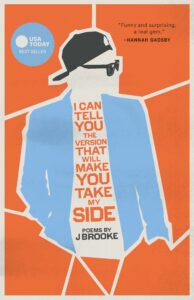
You can also read Brooke’s “The Name Dropper” published in Issue 10.1 of The Maine Review.
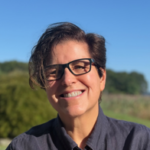
J Brooke
National Bestselling author J Brooke’s debut poetry book, I Can Tell You The Version That Will Make You Take My Side, received a starred Kirkus review, is a USA Today Bestseller, is a Ms. Magazine Best Poetry Book of 2026, a Kirkus Magazine Best Indie Book of November won Driftwood Press’s Editor Choice Award, and was Ashland Press’s 2025 Richard Snyder Prize Finalist. Among Brooke’s other honors they are a Pushcart & Best of the Net nominee, The Iowa Review’s 2025 Nonfiction Prize Finalist, Columbia Journal’s 2020 Nonfiction Prize Winner. Their work appears in Electric Lit, McSweeney’s, The Rumpus, and elsewhere. They are on the Board of Directors of Electric Lit, Poetry Editor at Trans Poetics Archive, the former Nonfiction Editor at Stonecoast Review, and the former Book Reviews Editor at The Rumpus. They can be found at JBrookewrites.com

Chelsea C. Jackson
Chelsea C. Jackson (they/she) is a writer, editor, consultant, and the author of the poetry collection All Things Holy and Heathen (April Gloaming, 2024). Their work asks hard questions, interrogates social narratives, and explores what it means to be human. Chelsea has an MFA from Drew University and is published in Passengers Journal, Fatal Flaw Literary Magazine, Hearth and Coffin Literary Journal, and Beyond Queer Words, among other publications. After moving around for more than a decade, they returned to their home state of Virginia in 2022, where they live with their partner and cuddly pitbull. You can connect with them at chelsea-jackson.com, via social media @sea_c_j, or via email at chelsea@mainereview.com.