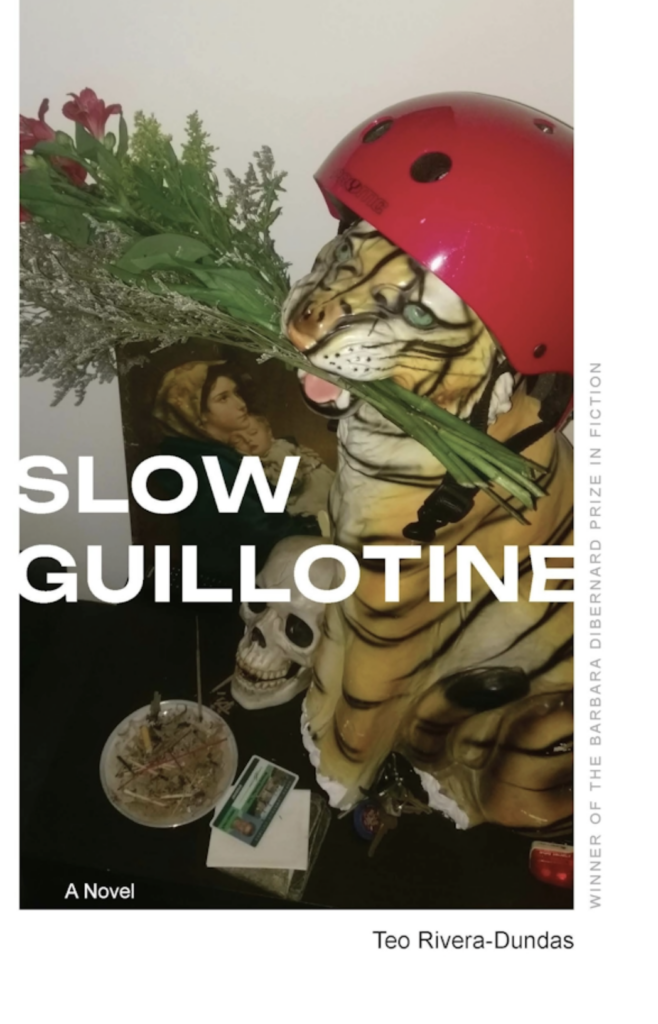
“It’s so easy to be right next to something and never experience it.” The sentence comes about a fourth of the way through Teo Rivera-Dundas’ debut novel and winner of the 2026 Barbara DiBernard Prize in Fiction, Slow Guillotine, and encapsulates a key theme of the book: adjacence. What does it mean to be adjacent to people, wealth, places, and art? How are the gaps in this nearness bridged? Can they be bridged at all?
In Rivera-Dundas’ book, we find three creative “weirdoes,” Precious, Felix, and our unnamed narrator, living in New York City in the mid-2010s. Each has their own artistic passions and goals, but carve out their survival at the periphery of what they love. This is most clearly seen in our (unnamed) main character, who works in the receiving room of a bookstore, laboring for an industry built on the literature they now feel distant from.
Not only is the sentiment of perceptible distance at the center of Slow Guillotine, I would say a sort of inverse is also present—that one can be thrown into an experience, routine, or even a life without knowing it or recognizing the cycle they’re in, lulled by empty promises of survival. Our main character recognizes themself as caught in this loop when they note:
“Every day I have the feeling that something will change, that I will change, but then the day starts and I’m off doing whatever it is I need to be doing, and then another day starts. Or it feels like I’m constantly recovering from the last thing that happened, and during the recovery process I forget what that thing even was. And then I start over…Even if I manage to diagnose whatever the problem actually is, this myopia, this frictionless space, it’s just going to stay there, observed by me but unchanged. So, what am I for? Reacting to the things around me, but in such a minor, toneless way it is as though I have remained completely still…a total creation of my circumstances. Part of the landscape basically.” (pg. 145–146)
And yet, even in this unmoored, “frictionless” space, Precious, Felix, and our narrator find solace and celebration in one another. Importantly, Rivera-Dundas creates rich characters without providing much direct description, especially as it relates to gender or race. This choice cleverly spotlights and challenges our near-constant desire (as readers and people) to categorize one another—a point furthered by the fact that we often learn more about the identities of our protagonists when they are being treated differently or misgendered by passing characters working out of their own assumptions and self-projected categories.
By moving so unapologetically beyond these categories, the reader is dropped into the familiarity shared between these friends and witnesses how each character is made more complex in their relationship to and with each other. It is this character-driven approach that enables Slow Guillotine to unfold less as a continuous narrative and more as vignettes and moments, or “non-moments,” occurring throughout the characters’ daily lives.
Even place functions as its own character, especially the friends’ shared apartment (aka “the gender loft”)—a living collage filled with furniture, décor, and half-working appliances collected from the streets and alleys of New York. This backdrop, where so many philosophical questions and conversations arise, embodies their attempt to build a life that is simultaneously permeated by overconsumption and want. The selfhood of the gender loft is made even clearer as our protagonists watch their neighborhood and building fall to endless construction, until, bit by bit, each apartment around them is “murdered” by a gentrification they both contribute to and are victims of. Another moment of adjacence—of being at the will of the landscape and the powers that build it.
Still, despite the challenges and moments of resignation our characters face, there is still hope. Throughout the book, we are reminded again and again that “adjacent” doesn’t mean “parallel.” Adjacence means intersection is possible, centering oneself is possible, movement is possible, if one decides to act. But the agency of Slow Guillotine isn’t commanding. It shows up quietly, almost practically. Our characters stop paying their rent, they celebrate birthdays, make art that won’t hang in galleries, cook for each other, take trips outside the city, these tiny rebellions that, even if just for a moment, trip the system and center themselves. Of course, as in real life, their agency also doesn’t always work and runs into its own limitations of the landscape. There are still realities our characters navigate: slumlords, shitty bosses, gentrification, racism, poverty; they continuously “[P]lay at apocalypse. [And] continue doing the same stuff.” And yet, most days, the intentionality and movement remain, a pull toward something greater than survival that exists even when they can’t articulate why they care or celebrate or try.
In an interview with Sarah Yanni, Rivera-Dundas acknowledged the various “core” themes that thread through Slow Guillotine—friendship, labor, city-living, the interrogation of art and capitalism—and noted that “the flux is the point.” We, like the narrator, are supposed to feel the distance of observation, of feeling outside clear direction or meaning. Only when we acknowledge and intentionally engage with this flux can we set out trying to weave some sense of pattern and understanding. We see this intentional choice, this commitment to pulling oneself closer to what and who matters in the last pages of Slow Guillotine, as the narrator sits to write the book itself, refusing to remain decentered by an industry set on turning the art they love into hollowed-out, lucrative entertainment. In choosing to write, the narrator leverages their own sense of creative power and agency.
It’s strange to think how much has changed from the 2015 setting of the book to now, and yet, so much is still the same, or the same in a different way. Today, adjacency—this nearness without actually touching or experiencing—remains among people, wealth, places, and art, especially amid the continued rise and threat of generative AI. And yet, Slow Guillotine is a reminder that no matter how small or disempowered our choices might feel, we can still choose to bridge the gaps as we are able. We can still decide to create no matter who sees. We can live intentionally and not sleepwalk through systems that benefit from our disembodied exhaustion. And above all, we can choose each other. We can commit to creativity and to an unapologetic sense of self that is welcomed by the world, yes, but most importantly by those we build a life with and around, those we commit to understanding and loving, too.
Available at the University of Nebraska Press

Chelsea C. Jackson
Chelsea C. Jackson (they/she) is a writer, editor, consultant, and the author of the poetry collection All Things Holy and Heathen (April Gloaming, 2024). Their work asks hard questions, interrogates social narratives, and explores what it means to be human. Chelsea has an MFA from Drew University and is published in Passengers Journal, Fatal Flaw Literary Magazine, Hearth and Coffin Literary Journal, and Beyond Queer Words, among other publications. After moving around for more than a decade, they returned to their home state of Virginia in 2022, where they live with their partner and cuddly pitbull. You can connect with them at chelsea-jackson.com, via social media @sea_c_j, or via email at chelsea@mainereview.com.